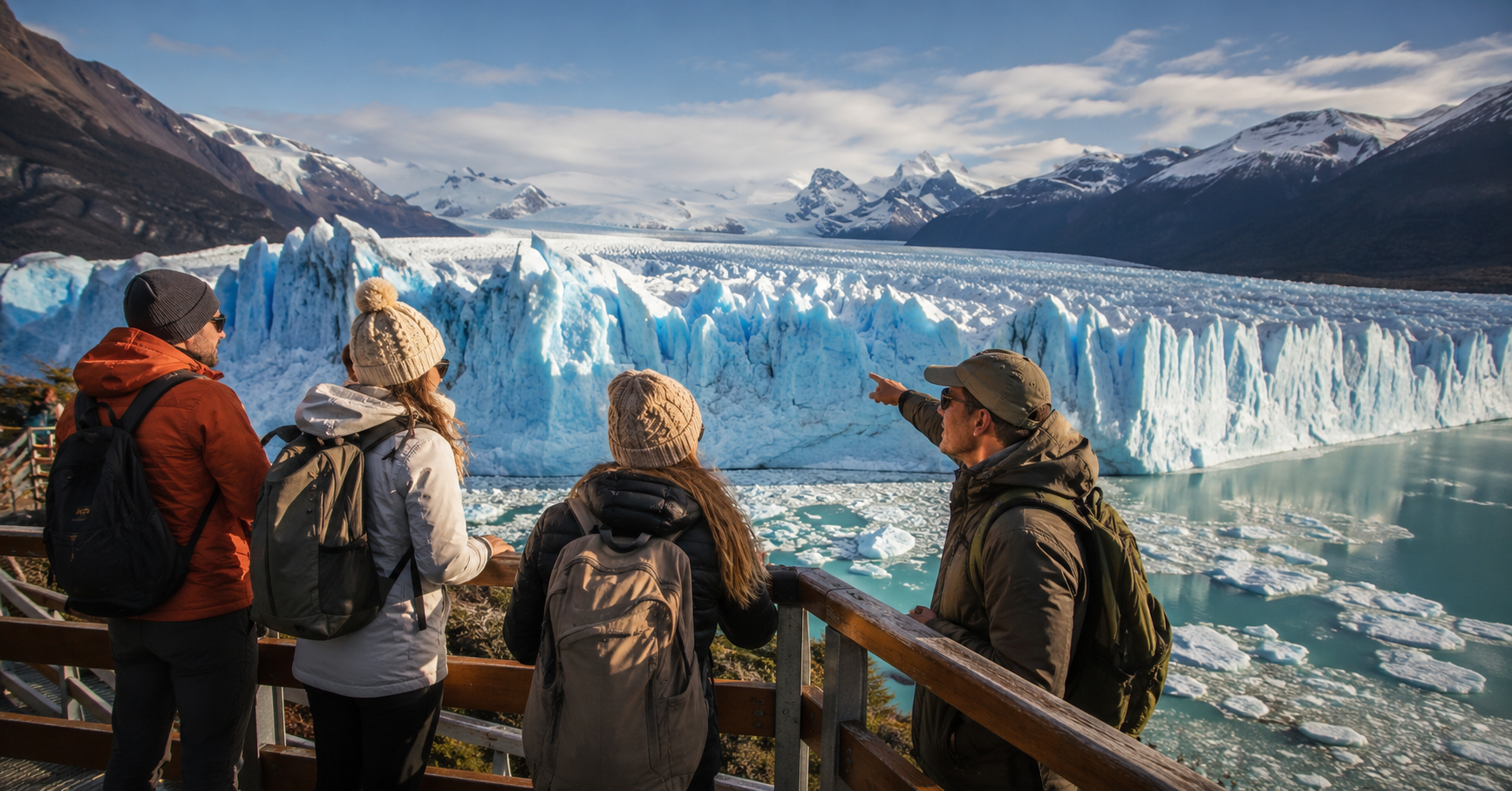
Perito Moreno Glacier: everything you need to know before you go (and why a guide is worth it)
The Perito Moreno Glacier is one of the seven natural wonders of the world and the main attraction of Argentine Patagonia. It's also one of the few glaciers on the planet that isn't retreating: it keeps actively growing, and its 5-kilometer-wide, 60-meter-high front constantly renews itself with spectacular ice calvings that sound like thunder.
We travel to the Perito Moreno Glacier every day of the year. This guide is written from that daily experience, not from tourist brochures.
In high season (October to March), the glacier receives up to 3,000 visitors a day. Ice trekking (Mini Trekking and Big Ice) sells out 2 to 3 weeks in advance. Book with us from Buenos Aires before flying south to secure your spot.
What exactly is the Perito Moreno Glacier?
The Perito Moreno is an outlet glacier that descends from the Southern Patagonian Ice Field and empties into the Rico Arm of Lake Argentino. It covers 250 km² with an average thickness of 170 meters. What makes it unique in the world is that its advancing front reaches all the way to touch the Magallanes Peninsula, periodically causing the rupture of the natural ice dam — a spectacle of epic proportions.
It's part of Los Glaciares National Park, declared a UNESCO World Heritage Site in 1981.
When is the best time to visit the glacier?
High season: October to March
The southern summer offers long days (up to 17 hours of daylight in December), more stable weather, and temperatures between 5 and 20°C. It's the ideal time for ice trekking. The downside: lots of people. Book anything trekking-related well in advance.
Low season: April to September
Patagonian winter has its own magic: the glacier under fresh snow, the lenga forests in ochre and reddish tones in autumn, and a solitude that doesn't exist in summer. Temperatures drop to -5°C or -10°C, but the visual experience is just as impressive. The panoramic walkways are open all year.
The best time of day to visit
Early morning (8 to 10am) and late afternoon (4 to 6pm) have the best photographic light and fewer people on the walkways. Midday is when there are the most visitors and the light is flattest. If you're doing ice trekking, the schedule is set by the operating company.
The three types of visit: which to choose
1. Panoramic walkways (no extra cost beyond park entry)
The National Park has a network of wooden walkways that runs along the glacier front at different heights and angles. The visual experience is extraordinary — you can stand less than 50 meters from the ice front and hear the calvings in real time. It's free with park admission (USD 25 for foreigners) and can be done without a guide.
2. Mini Trekking — for those who want to set foot on the ice
The Mini Trekking includes a 20-minute boat crossing to the glacier, technical equipment (crampons, poles), and 1.5 hours of guided walking on the ice, ending with a toast of whisky chilled with glacier ice. No prior experience needed. Total duration: 4 to 5 hours. OnlyPatagonia runs this excursion with certified guides every day in season.
3. Big Ice — the expedition experience
Big Ice is the extended version of the trek: 4 hours on the ice, with ascents and descents through sectors the Mini version doesn't reach. It requires good physical condition and several hours of sustained outdoor activity. Spots are limited to 16 people per departure. It's OnlyPatagonia's most in-demand experience and the one that sells out earliest.
OnlyPatagonia also arranges private visits to the glacier with access to the viewpoints before the walkways open to the general public (5:30 a.m. in summer). The image of the glacier at dawn, without a single person in the frame, is one of a kind. Available on request.
What to bring to the glacier
For the walkways: sneakers or boots with good soles (the walkways can be wet), layered clothing, an essential windbreaker (the wind at the glacier front can be very intense), sunglasses, and sunscreen.
For the trekking: the operator provides crampons and poles. Bring warm layered clothing (including a thermal layer), gloves, a hat, a windbreaker, and high boots with good soles. What you wear under the technical gear matters a lot.
OnlyPatagonia
Mini Trekking · Big Ice · Private walkways · Transfer from El Calafate included